Compare the whole transfer
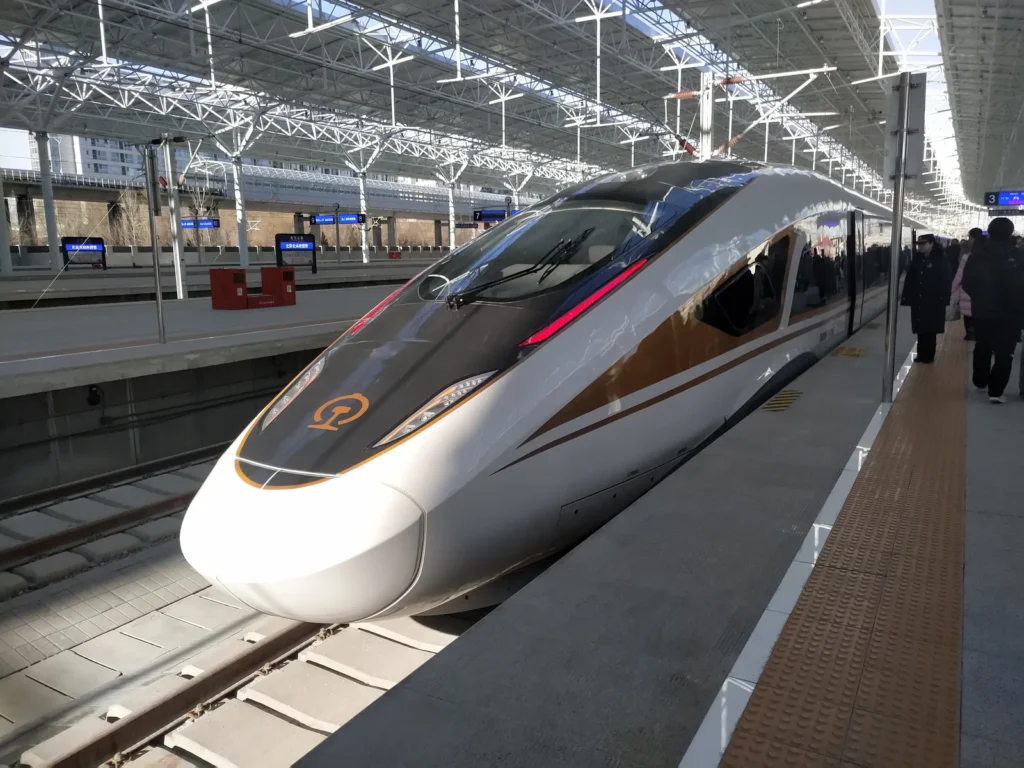
Photo: Vikarna / Wikimedia Commons / CC BY-SA 4.0.

A two-hour flight and a five-hour train are not a two-hour move and a five-hour move. The time printed on the ticket is only the middle of the transfer.
For the train, the sequence is hotel, railway station, the station process, the train, the arrival station, and the next hotel. For the flight, it is hotel, airport, check-in, security and waiting, the flight, the arrival airport, and the next hotel. None of those steps has one duration that fits every city. The useful question is which complete sequence works better for this trip.
That question only comes up after you have already decided to move. How much of the calendar that move will consume sits in how many days you need. Whether the extra city is worth a move at all sits in how many cities to visit.
The train often wins time before and after the ride
The useful advantage of rail is not that every station is downtown. Some major stations are convenient to the part of the city you are using. Others sit well away from the hotel. A city can also have more than one station, and the closest name on a map may not be the station your train uses.
What rail can avoid is the airport sequence: the ride out, the earlier arrival, and the process before the vehicle moves. When the station you will actually use connects cleanly with the hotel and the next part of the day, that saved ground time can matter more than a shorter flight in the timetable. When the station is remote, or you have chosen the wrong one, the advantage shrinks. How the railway process works, once the ticket exists, is in China high-speed rail.
A foreign passport can be used to buy railway tickets through the 12306 English service, subject to the required identity verification. Your passport is the identity document associated with the booking. The railway is not a mode you have to set aside because you are visiting. The steps for buying and entering are in that rail guide, not here.
Flying starts to make more sense when the ground distance grows
A flight can compress the middle of a long move across the country. That becomes relevant when the rail journey would take most of a usable day, a direct flight exists, both airports fit the hotels, and the departure and arrival times still leave you a day you can use.
Shanghai to Hangzhou is not the same decision as Shanghai to Chengdu. The first has direct high-speed rail service between the two cities. The second is a move into a different part of the country. Distance changes what you are comparing. It does not make the flight the automatic choice for the longer pair, and it does not make the train the automatic choice for every shorter one. There is no hour on the timetable where one mode takes over.

A direct route matters more than the vehicle
The comparison is this train against this flight, on this date, not trains against planes in general.
A direct train can be the simpler move when the flight alternative is an airport, a connection, and a second flight. A direct flight can be the simpler move when the rail alternative is a train, a connection, and a second train. Each extra vehicle inside the journey adds waiting, another platform or gate, and another place for the plan to slip. Look at the itinerary in front of you. A route database will not settle it.
Look at the departure and arrival, not only the duration
A departure at 07:00 and a departure at 13:00 do not take the same piece out of the trip, even when the ride is the same length. A late arrival can still cost the evening: the ride to the hotel, check-in, and a next morning that starts tired.
Ask what has to happen before you leave, and what you wanted to do after you arrive. A slightly longer journey can be the better one if it protects the hours you came for. That is the same usable-time idea as the days article. The clock on the ticket is not the whole cost.
Luggage changes the comparison
Significant luggage adds friction at every handling step, not a single national weight limit. Flight allowances depend on the airline and the fare. Rail has its own rules. Neither belongs in a fixed comparison here.
What you can compare is practical. How does the luggage get to the station or the airport? Does this flight ticket include what you are actually carrying, or does the fare assume a smaller bag? How many times will the bags be checked, carried through a hall, or loaded again? A mode with fewer of those steps can be easier even when the ride itself is longer. The kilograms are a ticket question. The friction is the decision.
Price is the fare plus the transfer around it
Neither trains nor flights are simply the cheaper way. The fare moves with the route, the date, the seat or cabin, demand, and the conditions on the ticket.
A cheap flight can still add the ride to the airport, and a baggage charge if the fare does not cover the bags. A train can still add a long ride to a distant station, or a more expensive seat if that is the one you are willing to sit in for hours. Compare the cost of the whole move. The number on the booking page is not automatically that cost. This page is not a fare table.
Reliability is not a reason to make absolute claims
A national punctuality ranking, in either direction, needs a dataset this decision does not have. It also does not tell you what to do with the journey in front of you.
If the timing is critical, especially before an international departure, leave margin whichever mode you choose. Do not place a long domestic transfer against that departure just because the timetable appears to fit. The margin is a planning choice, not a verdict on either system.
Sometimes the train ride is part of the day
Not every traveler is trying to minimize elapsed time. A long seat on a train can be a block for reading, working, or resting, and the landscape is there if you want it. That is a preference, not a reason to call the ride scenic by default. Someone else may want the shorter flight because they do not want those hours on a train. Both are legitimate. Efficiency is one input.
Make the decision simple
Check whether there is a useful direct train. Then check whether there is a useful direct flight. Compare hotel-to-hotel time, when you leave, when you arrive, where the station and the airport actually are, how many changes sit inside the journey, what the luggage has to do, what the whole move costs, and what the trip needs before and after.
Choose the option that fits the trip with less friction. Whether rail or a flight is the right kind of move for this distance, before you are holding a specific ticket, also sits in getting around China. The fastest vehicle is not always the fastest transfer.