Start with the train you are actually taking
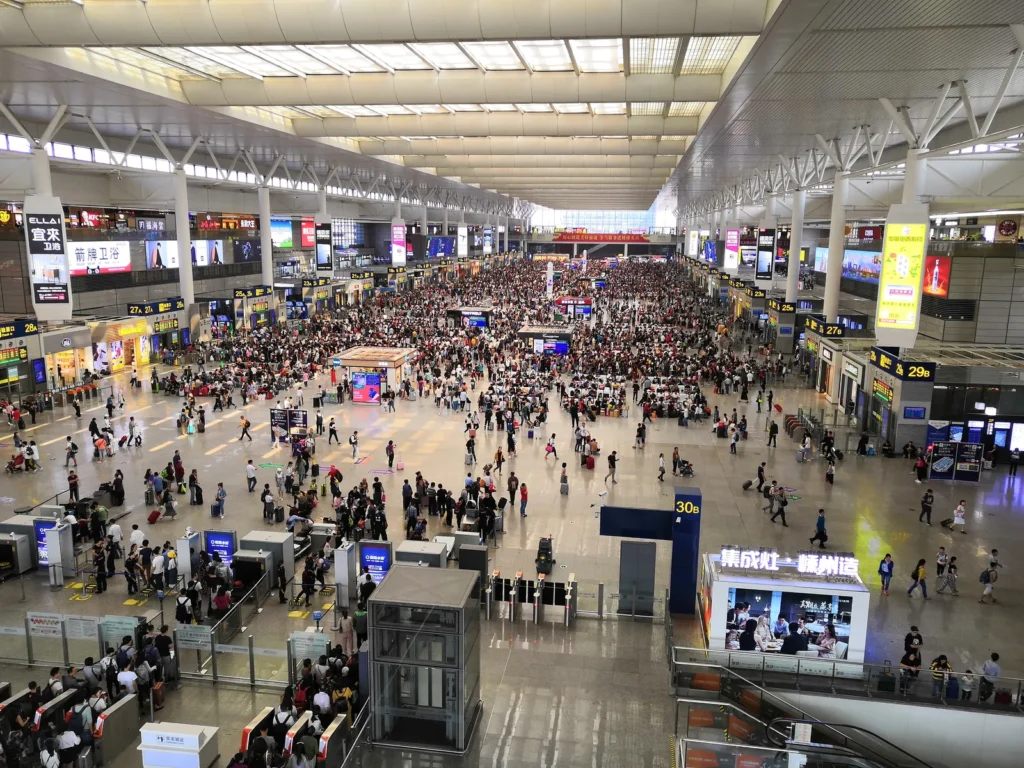
Photo: BlueSkySummer / Wikimedia Commons / CC BY-SA 4.0.

China high-speed rail is a specific ride, not a category you can book by mood. The useful question is whether the train in front of you is the fast one you think it is, and how long that particular journey takes.
The booking shows a code, and the letter is the category. A G is a high-speed EMU. A D is an EMU. A C is an intercity EMU. They are not the same service. Z, T, and K are conventional trains. Two of them can share a route and still take very different amounts of time. Read the code and the journey time. Do not book “a train to Shanghai” and assume the railway has handed you a high-speed seat.
Whether this city pair should be a train at all, rather than a flight, is a different decision. That sits in getting around China. This page starts after the ticket exists, and follows what happens from the station door to the platform and out the other end.
Your passport is part of the journey
The ticket belongs to a person, and the person is identified by a document. Foreign passengers can buy real-name rail tickets with a valid passport. On the English 12306 site, that is the only document the site accepts: a valid foreign passport. Enter the name and the document number accurately. A shortened name, or a passport you are not carrying, is how a ticket becomes unusable at the gate.
A station window can sell against a wider list than the English website. That list includes a foreign permanent resident ID, a foreign exit-entry permit, and a few other papers issued for travel, alongside a foreign passport. Do not treat the website and the window as the same counter. If you bought on the English site, the document in your bag needs to be the passport on the booking.
For an e-ticket, you show that same document to enter the station, to board, and to leave. A printed itinerary is not a ticket. Paper tickets are still sold, so “no paper” is not a rule about every purchase. It is the rule for the electronic ticket: the document is what the station checks, not a printout you hoped would substitute for it. E-tickets and paper tickets are both described on 12306’s English FAQ.
Registering on that English site is not the same step as passing identity verification. The current passport-verification page says a ticket can be bought after the document information has been uploaded and identity verification has passed. Where that check is a manual review of the photos, the page currently says the review takes 3 to 5 working days. The railway’s identity-check notice is separate again: a foreign-passport record that is still pending or has failed cannot be used to buy, the original document can be taken to a station ticket window, and a foreign-passport holder can also submit photos on 12306. This page does not walk through those screens. How to get from the account to a booking in your name is in how to buy the ticket.
Carry the original document you booked with. If an automated gate does not process it, use the staffed channel. That is the same instruction at the entrance, at the boarding check, and at the exit. Needing the staffed channel is not, by itself, a sign that the ticket is wrong.
Make sure you are going to the right railway station
Chinese cities often have more than one railway station, and the English names are easy to collapse. Beijing Railway Station, Beijing South, and Beijing West are three different places. Shanghai Railway Station and Shanghai Hongqiao are two different places. A ticket that says Beijing South is not a ticket from whichever Beijing station is closest to the hotel.
Match the station on the booking to the station you are actually going to, in Chinese as well as English. 北京站, 北京南, and 北京西 are not interchangeable. Nor are 上海站 and 上海虹桥. Save the Chinese name where you can show it with the signal off. A map search for “Beijing station” is how people arrive at the wrong building with the right ticket.
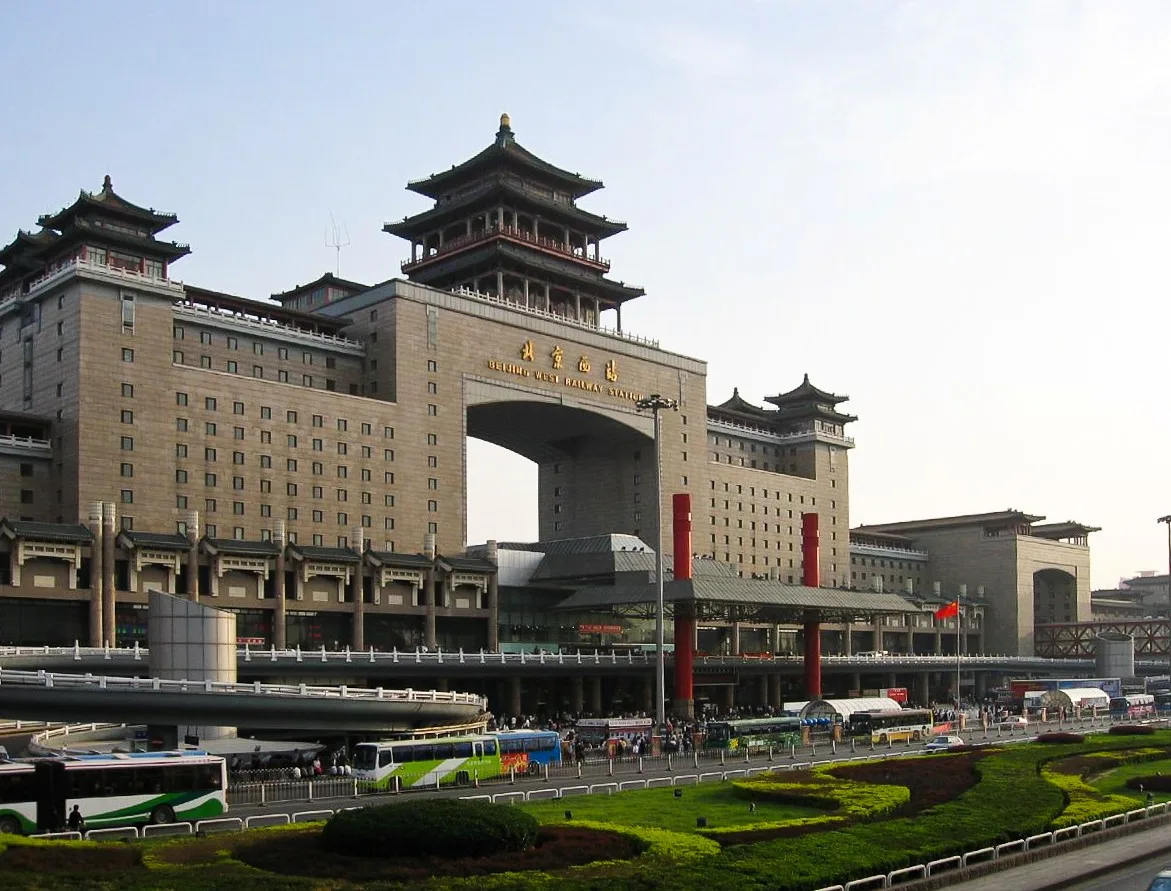

Then look at the trip from the hotel to that station, not to “the railway.” Some high-speed stations sit well outside the central district. Some older stations sit in it. There is no rule that the fast train uses the central one. The time that matters is the time to the station printed on this ticket. How to keep that Chinese name and a usable map on the phone is in essential apps.
What happens when you arrive at the station
A large station is a building you walk through, not a platform you step onto from the street. The ticket hall, the entrance, the security check, the waiting area, and the gate are separated by real distance. Queues at security and at the document check are normal, especially when a bank of trains leaves in the same hour.
You will be screened. Passengers and what they are carrying go through security. That is a legal requirement, not a busy-day extra. If you are carrying something you would not want to argue about at a scanner, the ordinary items worth checking are in the luggage section. The official catalog has the rest.
Have the original document out before you reach the check, not at the bottom of a suitcase. If an automated gate does not process it, use the staffed channel. Follow the signs for your train’s waiting area once you are through. The screens and the announcements name the waiting room, the gate, and when ticket check starts. Those are the instructions for this station today. A diagram you saw for a different station is not.
The departure time on the ticket is the scheduled moment the train leaves its origin station. It is not the moment you should walk in the door. Ticket sales and ticket checks stop before departure, and each station posts how long before. There is no single national number of minutes. For a first visit, leave enough time to be unfamiliar: the ride from the hotel, the walk inside, security, and finding the right room. That buffer is a practical allowance, not a railway rule. The official wording on departure time and on checks stopping early is on 12306’s note on entering the station.
Finding your gate and boarding the train
The waiting area and the gate belong to the train, not to the station in general. Your screen should show your train number, your carriage, and a gate or a check point that can change if the station reassigns it. Watch the board for your number. Do not follow a crowd onto a train with a similar departure time.
Boarding is another document check. Show the same original document you used to buy the ticket. On an e-ticket there is nothing else you are required to print. If an automated gate does not process the document, use the staffed channel. That is not, by itself, a fault in the ticket.
Ticket check itself stops before the train leaves. When it stops is on that station’s notice for that departure. Once you are through the gate, there is still a walk to the carriage. The carriage number and the seat are on the booking. Find those, then sit. Keep the passport where you can reach it again. You will want it at the other end, and you may be asked for it on the train.
What the carriage offers beyond a seat is not one national product. Power sockets, food, and English announcements show up on some services and not others. Do not plan the ride around a feature you have not seen on this train.
Which seat class should you choose?
The railway’s own list of seat categories is longer than three names. It includes second class, first class, business class, and others, plus sleepers on trains that have them. The list is a vocabulary, not a promise that your train has every word on it. The booking page for this train is the inventory. If business class is not offered, it is not on that train.
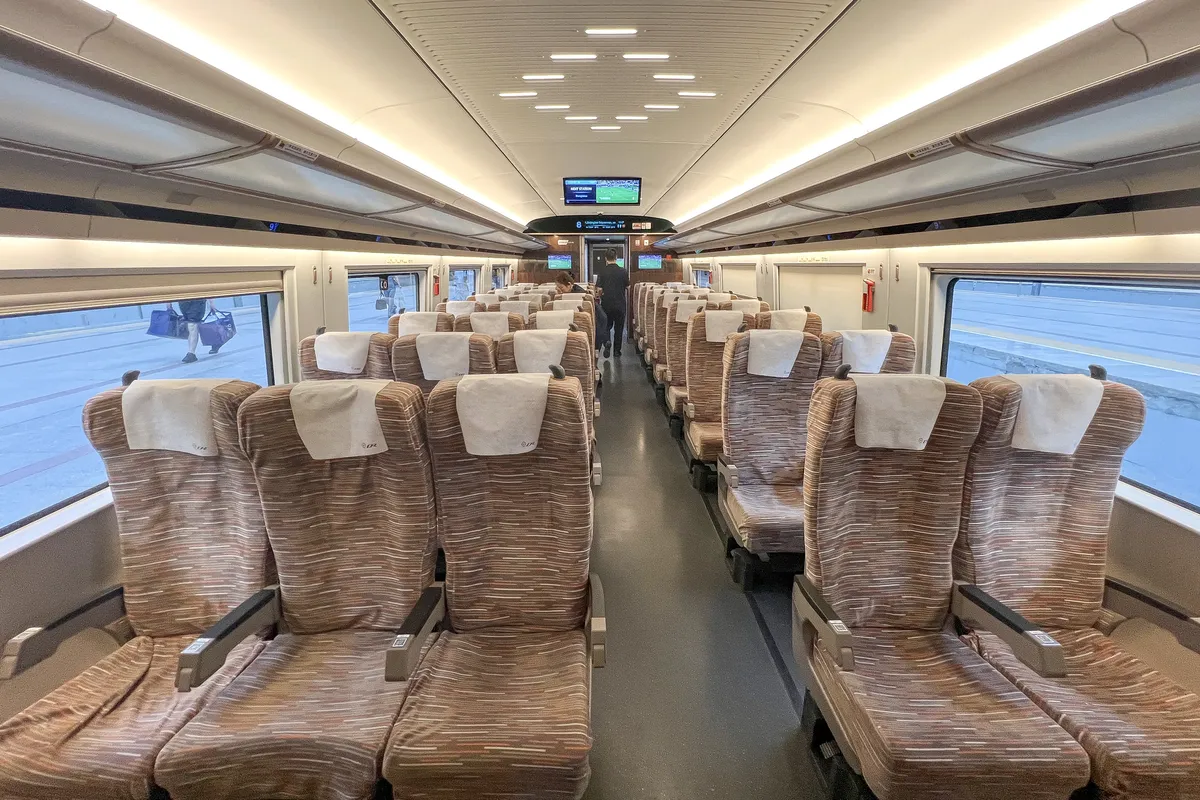
For an ordinary daytime high-speed ride, second class is the seat most visitors can stop thinking about. It is the standard seat, and it is enough for a few hours when you are not trying to work the whole way. First class is more room. Business class is the most space and the highest fare, and it is not available on every service. Paying up is worth it when this journey is long, or when the person traveling will feel the difference. It is not a rule, and it is not a better ticket in any official sense. The category names themselves are in the railway’s glossary of seat types.
.jpg)
What to know about luggage
You are not checking a bag the way you do on a plane. Ordinary luggage rides with you, inside the limits the railway publishes for free cabin luggage.
The current carry-on rule on 12306 is specific. An ordinary passenger may carry 20 kg free. A child may carry 10 kg. Each piece may weigh up to 20 kg. The length, width, and height of each piece add up to no more than 160 cm, and a rod-shaped piece no more than 200 cm, except on an EMU train, where each piece stays within 130 cm. Those are not airline figures. Use that page when you pack.
A normal travel suitcase inside those numbers stays with you. Consignment is a different service, for pieces that are not coming into the carriage. It is not how a suitcase boards a high-speed train.
Security is a separate list from the kilogram allowance. The catalog in force, republished on 12306, divides items into prohibited, barred from the carriage but allowed as consigned luggage, and limited. It is not the airline list.
Controlled knives are prohibited. An everyday blade longer than 60 mm, tools such as a saw, an axe, or a hammer, and blunt sports sticks such as a baseball bat or a hockey stick, cannot be carried on; the catalog allows them as consigned luggage. Undiluted alcohol, and any drink over 70 percent alcohol or with an unclear label, is prohibited. A sealed, clearly labeled drink from 24 to 70 percent is limited to 3,000 ml in total. Ordinary lighters are limited to two, and safety matches to two small boxes. A power bank needs a clear marking, and each one no more than 100 Wh. Perfume and similar non-aerosol toiletries are limited to one container of 100 ml per kind. Aerosol cans, such as hairspray, are limited to one container of 150 ml per kind, and 600 ml in total. Flammable, explosive, and corrosive materials are prohibited. If the bag holds anything less ordinary than clothes and a laptop, use the catalog rather than a guess.
What happens when you arrive
The train stopping is not the end of the journey. Confirm the station name before you get off. Cities have more than one, and a train can call at one of them on the way to another. Take the bag. Follow the exit for arrivals, not the one that leads back to departures.
Leaving uses the document again. For an e-ticket, the same original document that got you in is what you show on the way out. If an automated gate does not process it, use the staffed channel. Then you are in a station that may be as large as the one you left, and you still have to reach the hotel.
That last leg is metro, ride-hailing, or a taxi, depending on where this station sits and what you are carrying. The choice among those is the city half of getting around China, not a second railway problem. Have the hotel name and address in Chinese before you are in the exit hall. The station you arrived at is the one on the ticket. A car hailed for a different station in the same city is a long mistake.
Make the first train journey easy
One train is enough to prepare.
Know the code and the journey time, so you are on the service you meant, not a conventional train with a similar route. Know the exact station in Chinese, and how long it takes to reach that station from where you are sleeping. Carry the original document on the ticket, and use the staffed channel if a gate does not process it. Leave time for a building you have never walked through. Keep the seat choice ordinary unless this ride gives you a reason to pay for more room. Pack a bag that can stay with you.
The phone has to open the booking and the station name when you need them. How to keep a connection after you land is in internet for the trip. You do not need the whole ticketing system. If you plan to buy on 12306, finish the account and the identity check it requires before you are depending on that purchase. The ride itself is the station, the document, and the gate.