Start by checking which entry rule applies to you
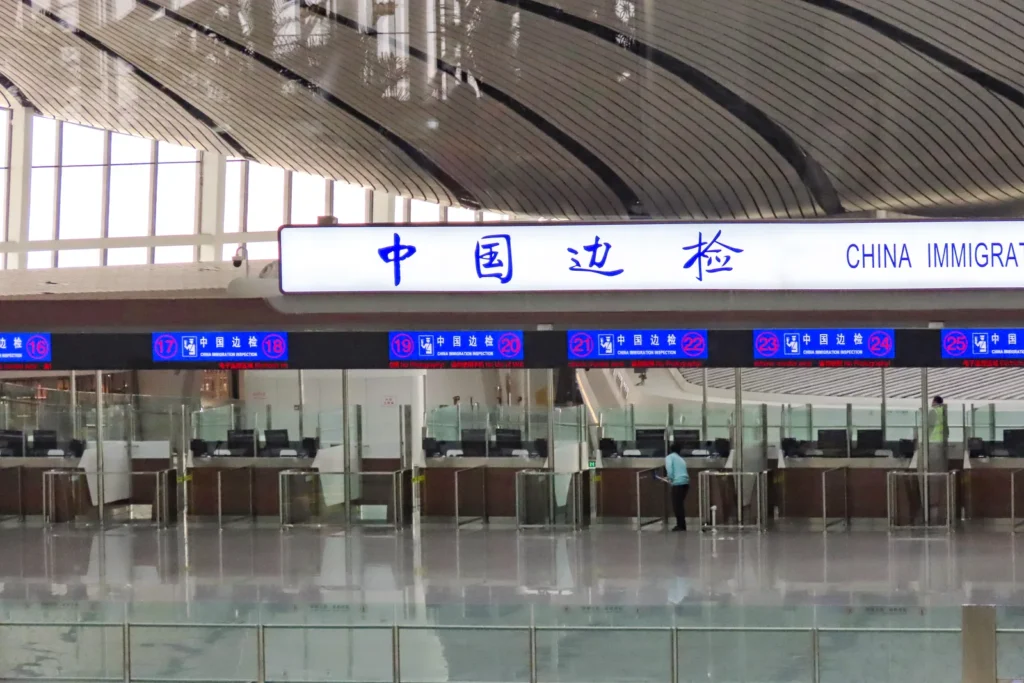
Photo: N509FZ / Wikimedia Commons / CC BY-SA 4.0. China Immigration Inspection counters at Beijing Daxing International Airport.
.jpg)
China entry requirements for tourists are not one rule for the whole plane. The permission that fits you depends on the passport you will carry, why you are going, and how long you will stay. Two people on the same flight can be entering under different rules, and both can be right.
Before you build a trip around an assumption, answer five questions.
- Which passport. Nationality is the first split. An ordinary passport from one country can be inside a visa exemption that the passport in the next seat is not.
- Why you are going. Tourism, a business meeting, and a family visit are not the same purpose as work, study, or news reporting. A short stay does not turn the second group into the first.
- How long you will stay. A permission that covers 30 days does not cover day 31. Count the nights you actually need, including a slow arrival and a late flight home.
- Whether China is the destination, or a stop on the way somewhere else. Visiting China and transiting through China are different permissions. An onward flight you do not intend to take does not convert one into the other.
- Whether you are relying on a special or regional arrangement. A rule that applies only inside one region does not automatically cover the rest of the mainland.
Name the route those answers produce: a visa, ordinary visa-free entry, or visa-free transit. If you cannot name it, you are not ready to pay for travel you cannot change. If the answer is unclear for your passport and your purpose, confirm it with the Chinese embassy or consulate responsible for you before that purchase.
Entry is one part of getting ready. Payment, a working phone, and the first hour after landing sit with the other things to settle before a first trip to China.
Some travelers can enter China without a visa
Ordinary visa-free entry is a short-stay exemption for certain passports. It is not a transit program, and it is not a rule for every visitor.
China has more than one ordinary visa-free route. The 50-country policy below is one major arrangement in force now. Separate bilateral visa-exemption agreements may also apply to some ordinary passports, and regional or special arrangements have conditions of their own.
The Ministry of Foreign Affairs currently lists 50 countries whose holders of valid ordinary passports may enter without a visa for business, tourism, visiting family or friends, exchanges, or transit, and stay no more than 30 days. The National Immigration Administration publishes that list, compiled from the Ministry. The Ministry’s own FAQ is the page that also states how long each part of the policy runs.
Read the conditions together, not as a headline.
- The passport has to be an ordinary passport. A temporary, emergency, or other travel document is outside this exemption.
- The purpose has to be one the policy names. Work, study, and news reporting are not on it.
- The stay cannot be more than 30 days. The count starts the day after you enter and runs for 30 calendar days. A plan that needs longer than that needs the matching visa before you travel.
- You do not register the exemption with an embassy in advance. Border officers still examine the purpose, and they can refuse entry when it does not match, or when another legal ground applies.
The exemptions also have end dates, and the dates are not all the same. On the current Ministry FAQ, Brunei’s arrangement has no fixed end date, Russia’s runs through 31 December 2027, and the arrangements for the other 48 countries run through 31 December 2026. A date on this page can move. Check the FAQ again shortly before you fly, and use that page rather than an old copy.
Children use the same conditions as adults. You may depart for China from a country other than the one that issued your passport. There is currently no stated cap on how many times you may use the exemption, as long as each stay matches the purpose and the 30-day count. That is not room to work, study, or remain past the limit.
Bring a ticket that matches the trip, and a reservation for where you will stay. The Ministry recommends those papers as proof of purpose. They do not put a passport onto the list.
Bilateral agreements and regional rules sit beside this list, on their own conditions. A visa-free stay that applies only in Hainan follows Hainan’s list and stops at Hainan’s boundary. It does not cover the rest of the mainland. If your plan uses a regional rule, read that rule. Do not rename it as the national 30-day exemption.
What to do: find whether your ordinary passport is on the current list, confirm that tourism fits both the purpose and the 30-day count, and write down the end date that applies to that passport. If this exemption does not fit, check whether another official visa-free arrangement applies to your passport and itinerary. If none does, check the visa requirements.
Visa-free entry and visa-free transit are not the same thing
These two phrases get used as if they were one policy. They are not. Mixing them is how people buy the wrong ticket.
Ordinary visa-free entry is for a traveler whose destination is China, under an exemption that fits that passport, that purpose, and that length of stay. The 30-day policy above is the main version of this for tourists. The word “transit” appears inside that policy as one allowed purpose. That still means the 30-day exemption, for passports on that list. It does not mean you have switched over to the 240-hour transit regime.
Visa-free transit is for a traveler who is passing through mainland China on the way to a third country or region. The shape is country or region A, then mainland China, then country or region B. B has to be a third place under the transit rule you are using. China is the stop, not the holiday that starts and ends there.
A confirmed onward ticket is part of that shape. An unused reservation added so the itinerary looks like transit is not the same thing as a journey onward. The inspection is of the trip you are actually making.
There is also a much narrower 24-hour transit permission. The National Immigration Administration describes it as available at open ports to foreigners transiting to a third country or region, with a valid travel document and a confirmed onward flight, ship, or train ticket, for no more than 24 hours, and without leaving the port’s restricted area. Leaving that area requires a temporary entry permit from the immigration authority at the port. A day inside the terminal is not a day in the city, and it is not the 240-hour policy.
What to do: decide whether China is your destination or a stop. If it is the destination, use ordinary visa-free entry or a visa. If it is a stop, read the transit conditions in the next section and match them to the ticket you intend to fly. Do not call a 30-day holiday “transit,” and do not call 240-hour transit “ten days of visa-free tourism.”
How the 240-hour visa-free transit policy works
The 240-hour policy is a transit permission with a time limit and a geographic limit. Eligible travelers may use the time for tourism, business, visits, or family visits inside the permitted area. That does not make the policy a tourist visa, and it does not make every routing through China eligible.
On the National Immigration Administration’s transit page, dated 20 August 2026, the policy applies to nationals of 57 countries, including Russia, the United Kingdom, and the United States. An eligible traveler holds an ordinary passport and an onward ticket with a confirmed seat and a departure date, to a third country or region. Entry is through one of 65 designated open ports in 24 provincial-level regions, and the stay is inside the permitted areas for no more than 240 hours. The same page also describes that stay as no more than 10 days. Work, study, and news reporting still need the appropriate visa.
The conditions belong together. All of them have to be true for that itinerary:
- your nationality is on the current list of 57;
- you are using an ordinary passport;
- you are going on to a third country or region, not simply into China and back;
- the onward ticket has a confirmed seat and a departure date;
- you enter at one of the designated ports;
- you stay inside the area that port’s permission allows;
- you leave within the allowed time.
One miss is enough. A passport on the list does not make an undesignated port eligible, and a designated port does not let you leave the permitted area. Both lists change, so use the NIA page when you book and again before you fly.
If the itinerary cannot meet those lines, ask the embassy, consulate, or visa center that takes applications where you live whether that routing needs a transit visa. Do not relabel it as tourism to force another category.
What to do: put your nationality, your entry port, your onward ticket, and the area you will actually stay in next to the current NIA page. If every line matches, you can plan inside that frame. If one line does not, change the routing or get the visa the office tells you that trip requires.
If you need a tourist visa, check the requirements where you apply
A tourist visa is the L visa: permission, obtained before travel, to go to China for tourism. You need it when your passport is outside the exemption you wanted to use, when the stay is longer than that exemption allows, or when the purpose is tourism but the exemption does not cover you. The office that accepts the application decides whether to issue it, and for what validity, how many entries, and what length of stay.
There is no single worldwide checklist. The embassy, consulate, or official visa application center responsible for where you apply publishes the steps and the papers. An online form and a photo specification at one post can be organized differently at the next.
Application requirements can differ by country, and by the Chinese mission or visa center handling the application. The Chinese Embassy in the United States says that, from 1 January 2024, tourist-visa applicants within the United States are no longer required to submit a round-trip booking, a hotel reservation, an itinerary, or an invitation letter. Each application there is still decided on its own facts, and that notice covers the posts it names. A visa center elsewhere can still ask for flights, hotels, or an invitation. Use the list for your own post.
What you should expect to see, and then confirm on your own post’s page, is some combination of these:
- the passport you will travel on;
- a visa application completed the way that office asks, often online, plus a photo that meets its specification;
- trip papers — bookings, an itinerary, or an invitation — only if that office still requires them;
- proof that you may apply from the country where you are filing, when you are not applying in the country of your citizenship. That proof is whatever the post names, not a guess.
What to do: open the L-visa instructions for the embassy, consulate, or visa application center that covers where you live, and prepare what that page lists. If the stay will run past the visa-free limit, start while you can still change the dates.
Check your passport and travel documents before you fly
Two different validity rules get repeated as if they were one. They are not, and using the wrong one creates both false alarms and real problems at the counter.
For ordinary visa-free entry, the Ministry of Foreign Affairs asks for an ordinary passport valid at least for the time you intend to stay. Temporary and emergency documents are not accepted for that exemption. That border rule does not add a hidden demand for six months of validity.
Six months shows up on visa applications. The U.S. embassy notice asks for more than six months of remaining validity and at least two blank visa pages. Other centers often ask for the same kind of remaining validity and blank pages. That is a requirement of the application at that office, not a rule that every visa-free arrival must have six months left. If you are applying for a visa, follow that office’s line. If you are entering visa-free, follow the ordinary-passport rule, and still cover the stay you booked.
Then match the papers in your bag to the route you chose. A useful set, kept where you can reach it without unpacking a checked bag, looks like this:
- the passport you will present;
- the visa, if this route needs one, checked against your dates and the number of entries you will use;
- where you will stay, in a form you can show, including the address in Chinese when the booking prints it;
- the onward or return ticket when the route depends on it. Transit permissions require a confirmed onward ticket. For ordinary visa-free entry, tickets and a stay reservation are the proof of purpose the Ministry recommends;
- any extra paper that specific exemption or transit rule told you to carry;
- an offline copy of the official page you used, so a dead phone does not leave you arguing from memory.
What to do: a hotel booking does not stand in for a missing visa, and an onward ticket does not create a transit permission your port does not offer.
What to expect when you arrive in China
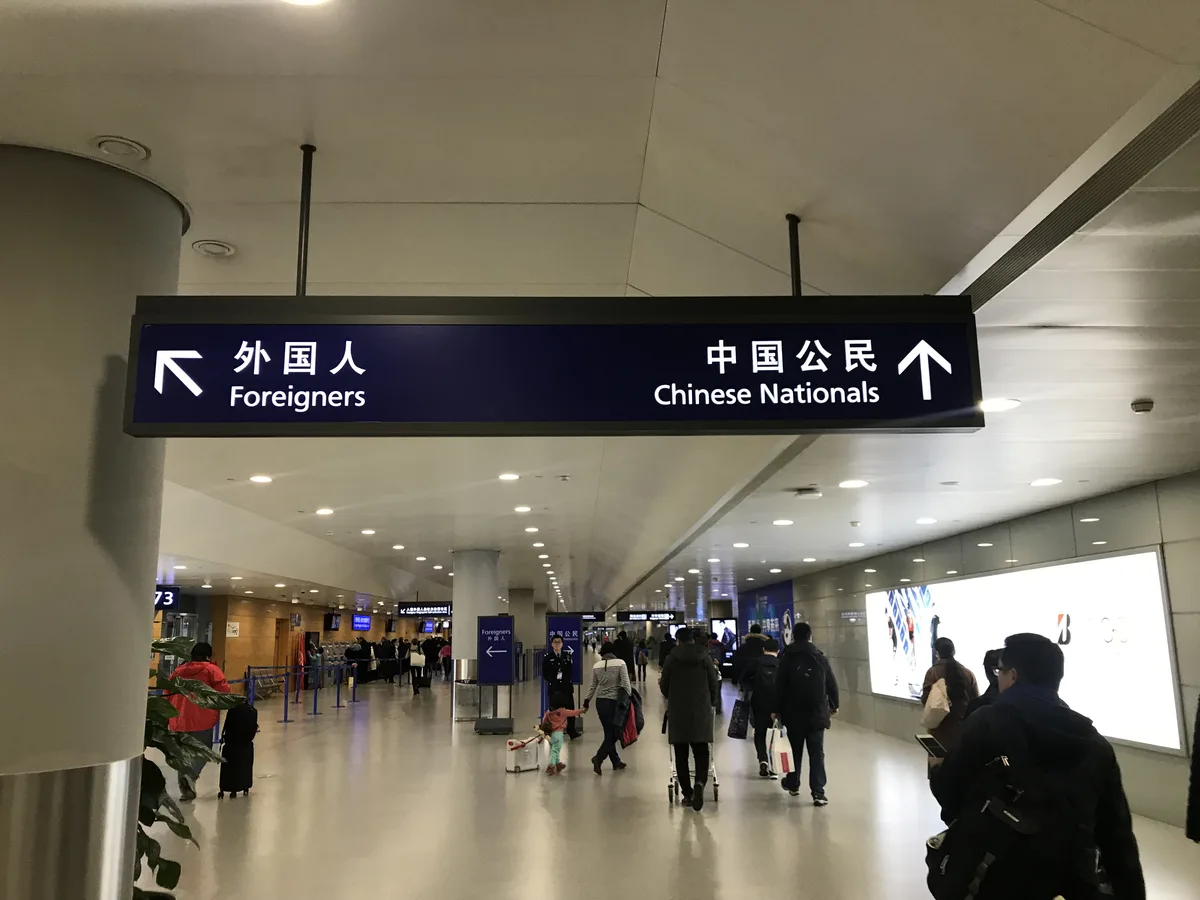
Arrival is an inspection. It is not a confirmation that the plan you made at home has already been accepted.
You will present your passport and, if you have one, your visa. If you are using an exemption or a transit rule, the officer can ask why you are there and look at the ticket and the place you will stay. The Ministry of Foreign Affairs is plain about the outcome: when the purpose matches the exemption, entry can be allowed after examination; when the purpose does not match, or another legal ground for refusal applies, entry can be refused. Qualifying on a webpage before you fly is not a promise that you will be admitted.

The same is true of transit. A 240-hour itinerary that looked eligible at booking still has to match the port, the onward ticket, and the area at the moment you arrive. A 24-hour transit that requires you to stay inside the restricted area means exactly that. Do not leave that area because the city is close.
After the inspection you collect your bags and clear customs. What you may bring in is a customs question, separate from whether you may enter. Have the hotel name and address in the bag you are carrying. Know how you will leave the airport. Those are arrival arrangements. They are not a second entry permit, and they do not repair a route that was wrong at the desk.
What to do: keep the passport, the visa if you have one, and the proof of your route on you. Answer for the permission you are actually using. If the officer’s question is about purpose, show the paper that matches that purpose, and stop there.
Check the official rule again before departure
Run this when you choose the route, and run it again shortly before you fly if you are relying on an exemption that has an end date.
- Which passport you will carry, and that it is the ordinary passport the rule requires.
- That the purpose is tourism, or whatever purpose you will actually declare. Work, study, and news reporting are a different application.
- How many days you will be on the ground, counted the way that permission counts them.
- Whether China is the destination or a stop on the way to a third country or region.
- Which permission that produces: a visa, ordinary visa-free entry, or visa-free transit.
- The current official page for that permission, not a saved copy from when you first looked.
- If a visa is required, that it has been issued and still covers the dates and the entries you will use.
- The ticket, the place you will stay, and any area limit that belongs to that route.
- An offline copy of the page you are relying on.
For ordinary visa-free entry, use the Ministry of Foreign Affairs FAQ and the National Immigration Administration’s list. For 240-hour and 24-hour transit, use the NIA transit page. For a visa, use the embassy, consulate, or visa application center that will take your application.
If the page and the itinerary disagree, change the itinerary or get the visa. Do not fly on the hope that the two will be reconciled at the desk.