Choose how you want to open DiDi
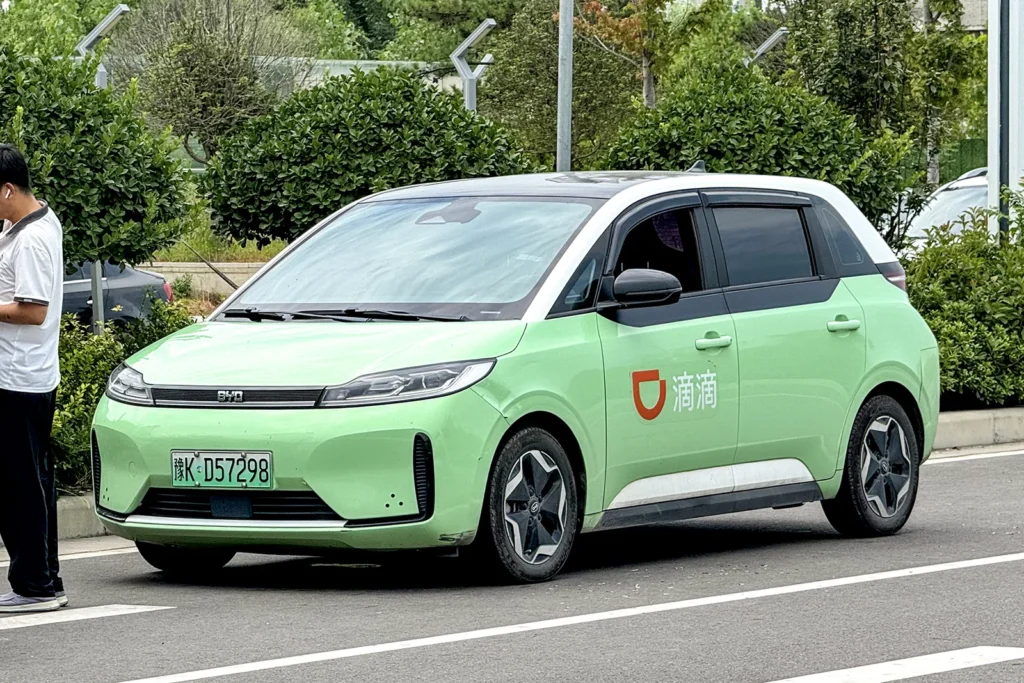
Photo: Windmemories / Wikimedia Commons / CC BY-SA 4.0.

A car in a Chinese city is a pickup problem before it is an app problem. You need a way to request the ride, a payment method that will actually be charged, and a pin that matches the curb where you are standing. DiDi is one of the main ride-hailing services foreign visitors will encounter in China. Alipay and WeChat are other doors into a ride. They are not the company that sends the car.
The current national guide for foreign travelers lists three ways in. Open Alipay, then Transport, then Taxi, and enter a pickup and a destination. Open WeChat, then Me, then Services, and look for Mobility or Ride Hailing. Or use the app the guide calls Didi-Greater China, confirm the pickup and the destination, and choose a service. That guide is the foreign-traveler chapter on the government site. City pages published later do not all use the same WeChat labels. Some say Pay and Services, and some say Ride Hailing under Services. Follow the words on your screen. Do not memorize one path and decide the app is broken when the label has moved.
The dedicated DiDi app can make sense if you expect to request this kind of car more than once. If Alipay or WeChat is already working, its ride-hailing entry can save you another account. Fewer tools is the better setup when one of those already solves the trip. Either way you are requesting a ride, not “opening a taxi.” On Alipay the national guide’s button is labeled Taxi. That label is the menu. It is not a promise that a metered cab is the only car that can arrive.
If you do install an app, install the official DiDi app used for ride-hailing in mainland China, not a DiDi passenger app meant for another country. Which listing is which is already in essential apps. When a car is the right tool, and when the metro already covers the distance, is in getting around China.
Set up your phone number and payment before the ride
The same national guide says the Didi-Greater China app lets a foreign visitor register with a foreign mobile number and an international credit card, and book once that registration is done. That is support for an overseas number. It is not a promise that every overseas number, on every network, will receive the verification text. Do the registration while you can still read that message. This page is not a SIM guide.
A card that already pays inside Alipay is Alipay’s card. It is not proof that the DiDi app will charge that card itself. The national guide says this app accepts an international credit card. DiDi’s own page says you add that card before the trip, and the fare is taken from it at the end. A ride opened inside Alipay or WeChat is paid through that app. How to get a foreign card working inside those wallets is in how to pay in China. Finish one payment path before you are standing at a curb with a driver already on the way.
Enter the pickup point and destination carefully
The dot on the map is a guess until you accept it. You can be inside a mall, on the far side of a divided road, or one level above the curb, while the app thinks you are “here.” The driver is then nearby and still unable to reach you. A hotel door is often a simple pin. A railway-station exit is often not. The station can have several exits, and the legal place for this kind of car can be a marked pickup area rather than the door you walked out of.
Look at the pin before you request the car. Move it to a curb a car is allowed to stop at. Read the entrance or the gate number, and which side of the road that entrance is on. If the station or the airport has a signed ride-hailing zone, the pin belongs there. The Chinese characters on that sign are often 网约车. A sign that only says taxi, or 出租, is a different queue. Do not assume the arrivals door is a place the driver can legally wait.
The destination needs the same care. An English hotel name sometimes resolves, and sometimes it resolves to a different property with a similar name. If the English result is ambiguous, use the Chinese name, or the Chinese address, and check the pin on the map before you confirm. Save that Chinese name where you can show it with the signal off. One ambiguous result is enough reason to stop and fix it. A wrong destination is a completed trip to the wrong building, and the ride does not undo itself.
Choose the car you actually need
On the Didi-Greater China app, the national guide names four services: Express, Taxi, Premier, and Luxe. They are options on that request, not a promise that all four exist in every city, at every hour, on every account, or inside Alipay and WeChat. If a name is missing from your screen, it is not on offer for this trip.
Taxi, in that list, means a taxi you have requested. It does not mean every DiDi ride is a taxi, and it does not mean the car at the official taxi rank is a DiDi car. Express is the ordinary ride-hailing option in the guide’s vocabulary. Premier and Luxe are the more expensive ones. For an ordinary daytime trip across town, the basic option on the screen is enough. Pay for a higher one when the luggage, the hour, or the people in the car give you a reason. That is a judgment, not a rule about fares.
When the screen labels that figure as an estimate, treat it as an estimated fare. It is not a promise that the amount taken at the end will match it, and it is not a national taxi tariff. This page will not publish a price per kilometre. China does not have one.
What happens after a driver accepts
The screen should now show a specific car, not “a DiDi.” Match the car and the plate on the booking before you open a door. A person calling “DiDi?” is not the check. The plate is the check.
You can call, and you can send a message. DiDi may provide translated or preset in-app messages, depending on the interface. That is not a promise that this driver speaks English, and it is not a promise that Alipay or WeChat will show the same control. If translation fails, the pickup pin, the gate number, and the Chinese destination still do the work. You do not have to conduct the meeting in Chinese.
Finding your driver at airports and railway stations
An airport pickup is a different building problem from a hotel door. Terminals are not interchangeable. Levels are not interchangeable. A ride-hailing pickup area may sit away from the arrivals door, because that door is for people walking out, not for cars waiting. A railway station can do the same thing with exits. The driver who “cannot find you” is often at the pin, on the legal curb, while you are at a door the pin never meant.
Follow the pickup point for the terminal or the station you are actually standing in. Read the signs for online ride-hailing, not only the signs for taxis. A level that worked at another airport is not the instruction for this one. If the signed zone is a long walk with heavy bags, or you cannot find it, the official taxi queue is a legitimate way to leave. It can be the simpler curb. It is not a failure, and it is not a second-class car. The rank and the app are two ways to get a ride when the metro does not start at the door you need.
What if you do not speak Chinese?
You can complete the request without holding a conversation. Where the app offers a language setting, use it. Do not assume every place name and every driver message will be in English. Keep the destination in Chinese when the English search is ambiguous. A translated chat does not fix a pin on the wrong exit.
The messages that actually come up are short. Which entrance. Which side. Can you walk to the pickup point. Answer with the gate, the sign, or a correction of the pin, not with a paragraph. You do not need a phrasebook for that. If you want one sign to recognize on the curb, 网约车 is the online ride-hailing pickup. 出租 is the taxi queue.
Payment, receipts and what happens after the ride
On the DiDi app, the international card you added is what the trip is charged to. DiDi’s page does not describe a cash fare for that path. A ride opened inside Alipay or WeChat is paid through that app. Watch the account that matches the door you used. If the card charge fails, check the card and try again.
The trip remains in the app after you get out. That history is the record of the car, the time, and the amount. This page is not a guide to Chinese invoices. If you need a receipt for an employer, use whatever the trip screen offers that day, and do not expect a paper slip from the driver as the normal end of an app ride.
During the ride itself, the useful checks are ordinary. The destination on the screen should be the place you meant. The car should be moving toward it. Wear the seat belt. Keep the bag you cannot afford to leave. You do not need to narrate the route.
What to do when the ride does not go to plan
If the driver cannot find you, assume the pin and your feet disagree. Look at which side of the road the car is on, and whether a barrier, a level, or a terminal door is between you. Walk to the pin, or send the gate number. If the driver asks you to move, the pickup point is the instruction. The arrivals door is not owed to you.
If the driver cancels, request again from the pin you have corrected, not from the same wrong dot. If you cancel, the trip screen is where that control lives. A cancellation fee is not one national number this page can print. Read what the screen says before you confirm. Timing, and how close the car already is, can change the result.
A payment that fails is the card or the wallet, handled as above. Something left in the car goes through that trip’s help inside the app. There is no separate lost-property office described here, and there is no single safety button this page can promise on every screen. Use the contact on the trip you are in. Then, if you still need a car, fix the pin before the next request.
Make the first DiDi ride simple
Do not make the airport curb the moment you discover that the phone has no data. Requesting the car, watching it arrive, and answering the driver all need a connection. How to have one after you land is in internet for the trip. Set up the number, the payment, and a test of that connection before you need the ride.
Then the first ride is small. Open the door you already prepared, DiDi itself or Alipay or WeChat. Put the pin on a curb a car can use. Put the destination in Chinese if the English result is vague. Choose the basic car unless you have a reason not to. When a driver accepts, match the plate. If the meeting fails, move to the pin rather than to a different door. Pay with the method that belongs to the door you opened.
You do not need the rest of the transport system to take that car. You need the pin, the plate, and a payment that can finish.